The SAMA CSF framework, run as a measurable maturity program
Govrly gives Saudi banks, insurers, financing companies, and credit bureaus one connected system for the SAMA Cyber Security Framework — every subdomain scored against the maturity model, every control owned, and every claim backed by evidence a SAMA examiner can follow.
- 4
- 32
- 6
- 3
This page reflects how we see these requirements applied in practice. It is not an official reference. The authoritative source is the current document published by the Saudi Central Bank (SAMA), which may be revised — confirm what applies to your organisation against it and with your own advisers.
What is the SAMA CSF framework?
From the compliance programmes we build and run in Saudi Arabia: the SAMA CSF framework is the mandatory cyber security framework issued by the Saudi Central Bank for all Member Organizations it supervises. It is structured around 4 control domains and 32 subdomains, and is assessed against a six-level maturity model running from 0 to 5. Every Member Organization must operate at maturity level 3 or higher across all applicable subdomains.
The Framework was issued in May 2017 under Circular No. 381000091275 and is maintained in the SAMA Rulebook, which holds the in-force text. It is principle-based rather than prescriptive: each subdomain sets out a Principle (why the control exists), an Objective (what it must achieve), and Control Considerations (the mandated measures). Where a Member Organization cannot implement a control as written, it is expected to formally document and accept the residual risk rather than silently omit it.
Subdomains are numbered in n.n.n format — 3.3.15 Cyber Security Incident Management, for example. That is not the NCA's n-n-n scheme. The two regulators use different numbering, and mixing them in a submission is a recognisable error to anyone reviewing it.
Who must comply with the SAMA CSF framework?
The Framework is mandatory for every Member Organization supervised by the Saudi Central Bank.
All banks operating in the Kingdom, including branches of foreign banks under SAMA supervision.
All insurance and reinsurance companies licensed to operate in Saudi Arabia.
Financing and finance-leasing companies operating under SAMA's regulatory authority.
All credit bureaus operating in the Kingdom.
The operators underpinning the Kingdom's financial market infrastructure.
All information assets — electronic and physical assets, software, applications, databases, networks, premises, and third-party services.
The four SAMA CSF domains
Each domain contains multiple subdomains, and each subdomain is scored independently against the maturity model. Thirty-two separate scores, not one.
Governance structure, the cyber security committee, strategy, policy, roles and responsibilities, and board-level oversight. Govrly holds approved policies with version history and traceable ownership, plus the committee reporting pack.
Risk management, regulatory compliance, review, and audit. Includes 3.2.4 Cyber Security Review and 3.2.5 Cyber Security Audits — the subdomains where evidence quality most often determines the score.
Human resources, asset and identity management, application and infrastructure security, cryptography, threat and vulnerability management, event and incident management. The largest domain, and where most Level 4 obligations sit.
Contracted services, outsourcing, and cloud computing. Cloud is subdomain 3.4.3 — it sits inside this domain rather than being a separate SAMA instrument, a distinction worth getting right in scoping.
The six-level maturity model
SAMA scores every applicable subdomain from 0 to 5. Level 3 is the regulatory floor, and a level can only be claimed once every requirement of the levels beneath it is already met.
Treating every subdomain as a uniform Level 3 target is the most common scoping mistake. Under a 2019 SAMA circular, banks were directed to develop a board-approved roadmap to reach Level 4 across a named set of subdomains covering cyber event management, incident management, threat management, and vulnerability management. Check your own supervisory correspondence — the obligations that apply to your institution are the ones SAMA has issued to it.
| Level | Name | What it means in practice |
|---|---|---|
| 0 | Non-existent | No documentation, and no awareness or attention to the control. |
| 1 | Ad-hoc | Activity happens, but inconsistently and without definition. Success depends on individuals. |
| 2 | Repeatable but informal | The practice is repeated, but it isn't formally documented or approved. |
| 3 | Structured and formalised | Controls are defined, approved, implemented, and compliance is monitored. The minimum SAMA expects. |
| 4 | Managed and measurable | Effectiveness is periodically measured and evaluated using KPIs and KRIs with defined thresholds. |
| 5 | Adaptive | Continuous improvement, with control performance integrated into enterprise risk management. |
Running SAMA CSF in Govrly
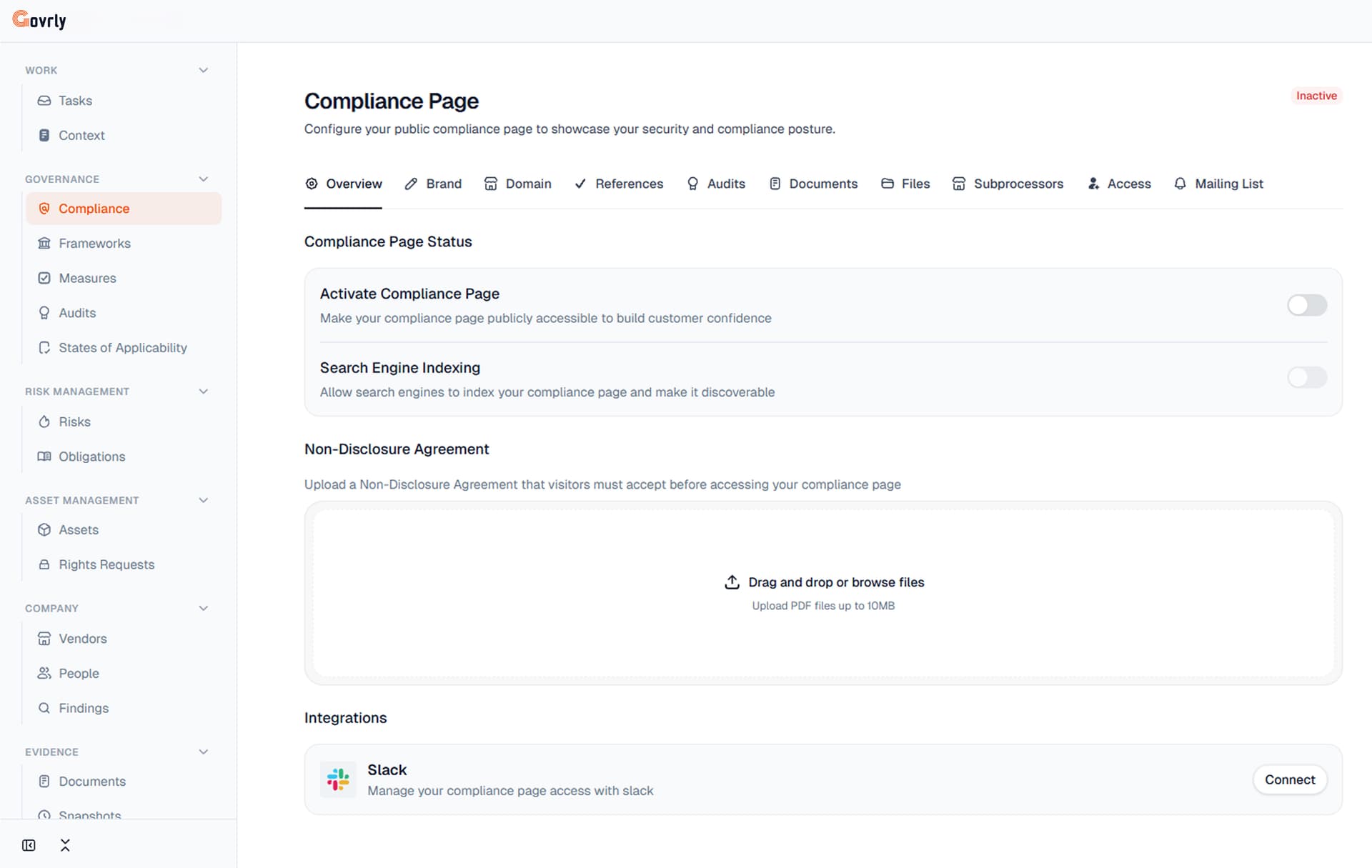
- A.
- Maturity per subdomainEach of the 32 subdomains carries its own maturity position with the evidence supporting it, so the gap between where you are and level 3 is visible continuously rather than at assessment.
- B.
- What actually moves a levelMaturity depends on whether a control is documented, operating and measured — the distinction between design artefacts and operating artefacts is where most subdomains score lower than teams expect.
- C.
- ECC work counts hereControls implemented for the ECC carry into CSF subdomains from the same record. For institutions holding both, this is where the duplicated effort disappears.
- D.
- Domain 3.2, evidencedRisk management and compliance is itself a scored domain. The register, its inherent and residual scoring, and the audit trail behind it are the evidence for that subdomain.
- E.
- Closed on verificationCorrective actions close when someone confirms them, not when the owner reports them — which is what stops the same finding reappearing at the next self-assessment.
- F.
- Board pack from live recordsCoverage and maturity by domain drawn from current records rather than rebuilt manually before each committee.
Why SAMA CSF programs stall at Level 2
The gap between Level 2 and Level 3 is not technical. It is evidential.
- 01/05The practice exists but nothing proves it
The control is genuinely operating, but there is no approved document, no monitoring record, and no way to demonstrate consistency. That is the definition of Level 2.
- 02/05Self-assessment scores are asserted, not evidenced
A spreadsheet says Level 3. The supporting artefacts sit in four systems and two inboxes, and nobody can assemble them on request.
- 03/05Level 4 is claimed without measurement
Level 4 requires KRIs and KPIs with defined thresholds and periodic evaluation. Without those, the score does not hold under examination.
- 04/05Third-party coverage is incomplete
Domain 3.4 requires visibility into contracted services and the cloud subdomain. Vendor records held outside the compliance system leave that domain unscoreable.
- 05/05The board pack is rebuilt every quarter
Manually, from stale inputs, which makes the governance requirements in domain 3.1 harder to evidence than they need to be.
How Govrly runs the SAMA CSF framework
All 32 subdomains carry an independent maturity score with the reasoning and artefacts behind it, so a score is defensible rather than asserted.
Every control consideration has a named owner, an implementation status, and a target date. Risk acceptances are recorded formally, not left as gaps.
Evidence is requested from an owner with a due date, reviewed before it counts, then linked to every requirement it satisfies across CSF, ECC, and ISO 27001.
Where Level 4 applies, control effectiveness is measured against defined thresholds and tracked over time — the specific thing Level 4 asks for and the specific thing most programs lack.
Posture, open risks, overdue actions, and maturity trend, drawn from live records rather than rebuilt by hand before each meeting.
Periodic self-assessment is assembled from records already reviewed and approved, with the supporting evidence attached to each score.
SAMA CSF vs NCA ECC
Many Saudi financial institutions carry both. Knowing where they diverge determines how much work you can reuse — and where you cannot cut corners.
| Feature | SAMA CSF | NCA ECC |
|---|---|---|
| Issued by | Saudi Central Bank (SAMA) | National Cybersecurity Authority |
| Applies to | SAMA-supervised Member Organizations | Government entities, affiliates, and critical national infrastructure |
| Structure | 4 domains, 32 subdomains | 4 main domains, 28 subdomains |
| Numbering | n.n.n (e.g. 3.3.15) | n-n-n (e.g. 2-3-3) |
| Approach | Principle-based, scored on maturity | Control-based, scored on implementation |
| Assessment | Maturity level 0–5, minimum level 3 | Implemented / partially / not implemented / not applicable |
| Business continuity | Out of CSF scope (CSF 1.3) | In scope — Cybersecurity Resilience domain |
| Managed in Govrly | Yes | Yes |
A practical path to SAMA CSF maturity
Movement from Level 2 to a defensible Level 3 typically takes nine to eighteen months, depending on institution size and the state of existing documentation.
- 01/07Confirm your applicable scope
Not every subdomain applies to every Member Organization type. Establish which apply to your institution, and record the basis for any exclusion.
- 02/07Baseline every subdomain
Score all 32 against the maturity model with evidence behind each score. An honest baseline is more useful than an optimistic one — SAMA will test it.
- 03/07Identify your Level 4 obligations
Check the circulars issued to your institution rather than assuming a uniform Level 3 target across the Framework.
- 04/07Close the documentation layer
Policies, standards, and procedures approved by the right body, versioned, and traceable to the subdomains they support. This alone moves several scores from 2 to 3.
- 05/07Stand up measurement where Level 4 applies
Define KRIs and KPIs with thresholds, and start collecting. Level 4 cannot be claimed retrospectively — it needs a measurement history.
- 06/07Bring third parties into scope
Contracted services, outsourcing arrangements, and cloud under 3.4.3, with the shared-responsibility position documented per provider.
- 07/07Operate the cycle
Self-assess periodically, keep evidence current between cycles, and track remediation to verified closure rather than to "in progress".
Maturity is scored against the same controls that carry your other frameworks, so moving a subdomain from level 2 to level 3 is a change to one record rather than a separate programme. Evidence collected for the ECC counts here too.
SAMA CSF framework FAQs
The SAMA CSF framework is the mandatory cyber security framework issued by the Saudi Central Bank for all Member Organizations it supervises. It is structured around 4 control domains and 32 subdomains, and is assessed against a six-level maturity model running from 0 to 5. Every Member Organization must operate at maturity level 3 or higher.
Four control domains and 32 subdomains. The domains are Cyber Security Leadership and Governance, Cyber Security Risk Management and Compliance, Cyber Security Operations and Technology, and Third Party Cyber Security. Subdomains are numbered in n.n.n format, such as 3.3.15 Cyber Security Incident Management.
Level 3, described as structured and formalised, is the minimum expected across applicable subdomains. A higher level can only be claimed once every requirement of the levels beneath it is already met. Certain subdomains carry a Level 4 obligation for some institution types, so check the circulars issued to your institution rather than assuming a uniform target.
All Member Organizations supervised by the Saudi Central Bank: banks operating in the Kingdom, insurance and reinsurance companies, financing companies, credit bureaus, and the financial market infrastructure.
No. Cloud computing is subdomain 3.4.3, sitting inside the Third Party Cyber Security domain of the CSF itself. There is no standalone SAMA cloud rulebook, despite the term appearing in circulating compliance material. Requirements relating to cloud, including pre-approval, are located within the CSF text.
No. The CSF contains no recovery time or recovery point figures, because business continuity is explicitly out of its scope. Any tiered RTO or RPO grid attributed to the CSF is not from the Framework. Business continuity obligations for SAMA-supervised entities sit in separate instruments.
Periodically, using the questionnaire SAMA provides. Self-assessment results are reviewed by SAMA and validated during supervisory examination, so the supporting evidence for each maturity score needs to be retained and retrievable, not reconstructed at examination time.
The SAMA CSF applies to financial institutions supervised by the Saudi Central Bank and is scored on a six-level maturity model. The NCA ECC is the cross-sector national baseline for government entities and critical national infrastructure, scored on implementation status. They overlap substantially at control level, but each has its own supervisor, numbering scheme, assessment method, and evidence expectations.
Moving from Level 2 to a defensible Level 3 typically takes nine to eighteen months, depending on institution size and the state of existing documentation. Institutions with a mature ISO 27001 program usually move faster, because much of the required evidence already exists in a reusable form.
Yes. Controls, measures, and evidence are shared objects in Govrly, so one implementation effort and one piece of approved evidence can support overlapping requirements across the SAMA CSF, NCA ECC, Saudi PDPL, ISO 27001:2022, and custom frameworks — while each framework keeps its own scoring method and its own reporting.
See every subdomain scored, owned, and evidenced
All 32 subdomains, the maturity behind each score, and the evidence supporting it — ready when the examiner asks.
