CST controls, mapped to your assigned compliance level
Govrly gives CST-licensed service providers one connected system for the Cybersecurity Regulatory Framework — every applicable control scoped to your compliance level, assigned to an owner, and backed by evidence ready for the annual self-assessment.
- 6
- 3
- 4
- 1
This page reflects how we see these requirements applied in practice. It is not an official reference. The authoritative source is the current document published by the Communications, Space and Technology Commission (CST), which may be revised — confirm what applies to your organisation against it and with your own advisers.
What are the CST controls?
From the compliance programmes we build and run in Saudi Arabia: the CST controls are the requirements of the Cybersecurity Regulatory Framework (CRF), issued by Saudi Arabia's Communications, Space & Technology Commission under Decision No. 424/1442. They are mandatory for organisations licensed or registered by CST, and are organised across six control domains and three progressive compliance levels — CL1, CL2, and CL3 — with the applicable level determined by the licensee's classification.
CST was formerly CITC, which is why the framework is still widely referred to as the CITC CRF. Both names describe the same instrument. The framework was issued in 2020 and has been updated since, so licensees should work from the current version published on the CST website rather than an archived copy.
The CRF is built on four pillars — Strategy, People, Technology, and Processes — and aligns with ISO 27001 and NIST. That alignment matters commercially: a service provider with an existing ISO 27001 program is not starting from zero, and much of the evidence already collected can carry CRF requirements directly.
Who must comply with the CST controls?
The CRF applies to organisations licensed or registered by CST as the regulator of the ICT, telecom, postal, and space sectors in the Kingdom.
Mobile and fixed network operators, and providers of licensed communications services in the Kingdom.
ISPs and providers of internet access and connectivity services under CST licence.
Hosting providers, data centre operators, and cloud infrastructure providers registered with CST.
Postal service providers and space-sector entities falling under CST's regulatory remit.
Entities classified as Critical National Infrastructure fall under the NCA's Essential Cybersecurity Controls. Establishing which regulator owns your obligation is the first scoping decision, not a detail.
Many licensees also carry PDPL obligations, and some carry SAMA CSF or Aramco CCC requirements. The CRF is designed to interoperate rather than duplicate.
The three CRF compliance levels
The CRF takes a risk-based, tiered approach. Each level builds on the one beneath it, so CL2 assumes CL1 is already in place and CL3 assumes both.
The baseline every in-scope licensee is expected to establish — a defensible floor against common threats.
- Cybersecurity governance and defined ownership
- Asset inventory and classification
- Basic access control and logical security
- Physical security of facilities and equipment
- Foundational risk management
Builds on CL1 with requirements addressing more sophisticated and evolving risk, and heavier evidential expectations.
- Formalised risk assessment and treatment
- Strengthened third-party and supply chain security
- Enhanced monitoring, logging, and detection
- Documented incident response capability
- Independent compliance verification
Focuses on efficiency, continuous monitoring, and ongoing improvement of the controls established at CL1 and CL2.
- Continuous control monitoring
- Measured effectiveness and performance review
- Mature threat and vulnerability management
- Programme-level optimisation
- Independent compliance verification
Your compliance level follows from your CST classification and the targets CST communicates to you — it is not self-selected. Confirm your applicable level and its current requirements against CST's published framework and any correspondence issued to your organisation.
The six CST control domains
Each domain maps to a working area of the platform, so the controls, the owners, and the evidence sit in one place rather than three.
Strategy, policy, roles and responsibilities, and management oversight. Approved documents with version history and traceable ownership, plus the reporting pack behind them.
Inventory, classification, and handling of information and technology assets, connected to the data they hold and the vendors and controls that touch them.
Identification, assessment, treatment, and monitoring of cybersecurity risk. A risk register with inherent and residual scoring, linked to the controls that mitigate each entry.
Access control, network and system security, cryptography, monitoring, and vulnerability management. Measures carry owners, implementation status, and linked evidence.
Protection of facilities, equipment, and environments — a domain that matters disproportionately for data centre and hosting licensees, and one that is frequently under-evidenced.
Suppliers, outsourcing, and service dependencies. Vendor inventory with agreements, certifications, assessments, and the controls each vendor relationship affects.
Running CST CRF compliance in Govrly
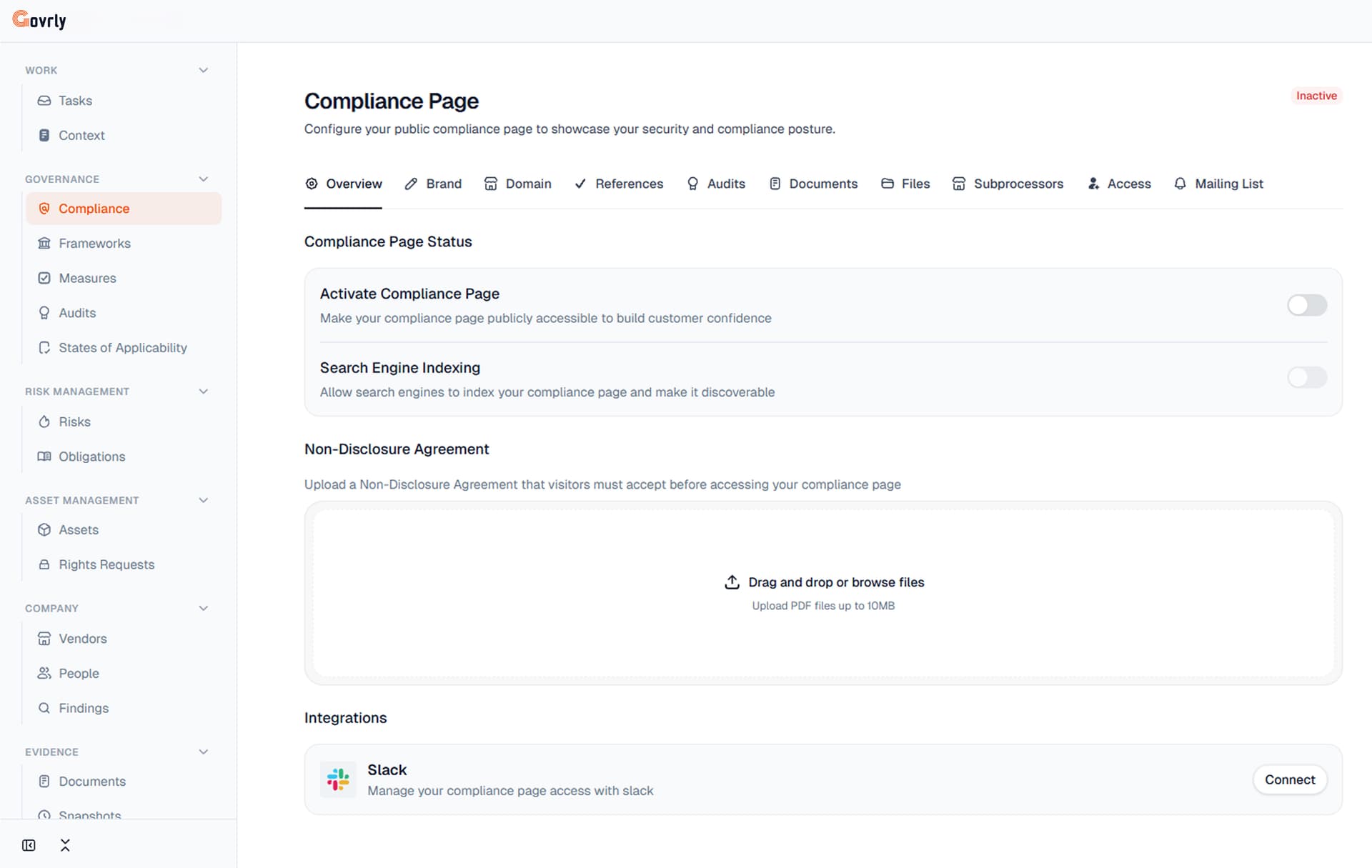
- A.
- Scoped to your assignmentThe control set reflects the compliance level CST assigned to your entity, so the programme is sized to what actually applies rather than to the full framework.
- B.
- Six areas, one libraryGovernance, asset management, risk, logical security, physical security and third-party security map onto the same controls carrying your other obligations.
- C.
- The domain most often thinPhysical security demands the same evidential rigour as the technical domains and is usually the weakest for hosting providers and data centres. Treating it as an operational control rather than a facilities matter is what closes that gap.
- D.
- Suppliers linked to controlsA vendor register connected to the agreements, certifications and the specific controls each supplier relationship affects — which is what domain six actually asks you to demonstrate.
- E.
- Mapped, not rebuiltThe CRF aligns with ISO 27001, so an existing ISMS maps across rather than starting again. For licensees already certified, this is the largest single saving available.
- F.
- Assembled, not manufacturedThe annual self-assessment is compiled across the six domains from evidence already collected and reviewed.
Where CST compliance goes wrong
The framework itself is not the difficult part. Sustaining it between assessments is.
- 01/06Scope is assumed rather than confirmed
Organisations work to a compliance level they believe applies rather than the one CST assigned. Every downstream decision inherits that error.
- 02/06The evidence pack is built once a year
Assembled in the weeks before submission, from systems that have changed since. What gets submitted describes a state that no longer exists.
- 03/06Physical security is treated as facilities' problem
Domain 05 requires the same evidential rigour as the technical domains. For hosting and data centre licensees it is often the weakest-evidenced area.
- 04/06Third-party dependencies are unmapped
Domain 06 cannot be evidenced without a vendor inventory linked to the services and assets each supplier touches.
- 05/06ISO 27001 work is redone instead of reused
The CRF aligns with ISO 27001 and NIST. Running them as separate programs means collecting the same evidence twice and reconciling two sets of findings.
- 06/06Independent verification arrives to no audit trail
Where independent compliance verification applies, an assessor needs to see how a control reached its current state — not just that someone asserts it is in place.
How Govrly runs CST CRF compliance
The controls applicable to your assigned compliance level, scoped once, with exclusions recorded and justified rather than silently dropped.
Every control carries a named owner, an implementation status, and a target date. Nothing sits unassigned between assessment cycles.
Evidence requested from an owner with a due date, reviewed before it counts as control support, and kept current — so the annual pack is assembled, not manufactured.
Inherent and residual scoring, with each risk connected to the controls that treat it and the evidence that proves they operate.
Findings with root cause, corrective action, owner, and verification — closing only when the verification step completes, which is what an independent assessor looks for.
Controls, measures, and evidence are shared objects. Implement once and satisfy the CRF requirement, the ISO 27001:2022 Annex A control, and the corresponding PDPL safeguard from the same record.
CST controls vs NCA ECC
These two are frequently confused, and the distinction determines which regulator you answer to.
| Feature | CST controls (CRF) | NCA ECC |
|---|---|---|
| Issued by | Communications, Space & Technology Commission | National Cybersecurity Authority |
| Applies to | CST-licensed and registered service providers | Government entities, affiliates, and critical national infrastructure |
| Sector | ICT, telecom, postal, and space | Cross-sector national baseline |
| Structure | 6 control domains, 4 pillars | 4 main domains, 28 subdomains |
| Assessment approach | Tiered compliance levels CL1–CL3 | Implementation status per control |
| If you are CNI | The NCA ECC applies instead | In scope |
| Managed in Govrly | Yes | Yes |
A practical path to CST CRF compliance
Sequence matters, because scoping errors made at the start propagate through every subsequent step.
- 01/07Confirm your classification and level
Establish which compliance level CST has assigned to your organisation, and record the basis. Do not proceed on an assumption.
- 02/07Run a gap assessment across all six domains
Score each applicable control as implemented, partially implemented, not implemented, or not applicable — with written justification for every exclusion.
- 03/07Map what ISO 27001 already covers
If you hold ISO 27001, identify the overlap before building anything new. This is usually the largest single saving available.
- 04/07Assign ownership
Every applicable control gets a named owner and a target date. A department is not an owner.
- 05/07Close the documentation layer
Policies, standards, and procedures approved, versioned, and traceable to the controls they support.
- 06/07Collect evidence continuously
Link evidence to each control as it is produced, rather than reconstructing it before submission.
- 07/07Compile and submit
Assemble the evidence pack across all six domains for the self-assessment, and arrange independent verification where your level requires it.
Your assigned compliance level scopes the control set once, and the six domains map onto the same controls and evidence carrying your other obligations. The annual self-assessment is compiled from current records rather than assembled beforehand.
CST controls FAQs
The CST controls are the requirements of the Cybersecurity Regulatory Framework (CRF), issued by Saudi Arabia's Communications, Space & Technology Commission under Decision No. 424/1442. They are mandatory for organisations licensed or registered by CST, and are organised across six control domains and three progressive compliance levels — CL1, CL2, and CL3.
Yes. CST was formerly the Communications and Information Technology Commission (CITC) and was renamed following its expanded remit. The framework is the same instrument, and both names refer to it. Licensees should work from the current version published on the CST website.
Organisations licensed or registered by CST as the regulator of the ICT, telecom, postal, and space sectors in Saudi Arabia. This includes telecom operators, internet service providers, hosting and data centre providers, and similar licensees. Entities classified as Critical National Infrastructure fall under the NCA's Essential Cybersecurity Controls instead.
They are the CRF's three progressive compliance levels. CL1 covers foundational controls, CL2 builds on CL1 with more advanced requirements addressing evolving risk, and CL3 focuses on efficiency, continuous monitoring, and ongoing improvement of the controls established at the earlier levels. Each level assumes the levels beneath it are already in place.
No. The applicable level follows from the organisation's CST classification and the compliance targets CST communicates to it. Organisations should confirm their applicable obligations against their formal classification rather than selecting a level themselves.
Cybersecurity governance, asset management, risk management, logical security, physical security, and third-party security. The framework is also described in terms of four pillars — Strategy, People, Technology, and Processes.
The CRF aligns with ISO 27001 and NIST, and supports interoperability with other Saudi regimes including PDPL and SAMA. In our experience, an organisation with an established ISO 27001 program will find substantial overlap at control level, and much of the evidence already collected can support CRF requirements directly.
The CST CRF applies to CST-licensed service providers in the ICT, telecom, postal, and space sectors, and uses tiered compliance levels. The NCA ECC is the cross-sector national baseline for government entities, their affiliates, and critical national infrastructure, and is scored on implementation status per control. Organisations classified as Critical National Infrastructure fall under the ECC rather than the CRF.
The CRF is published as a binding regulatory requirement for CST licensees, and non-compliance carries regulatory consequences alongside the underlying cybersecurity risk. Licensees should confirm the current enforcement position and any obligations specific to their licence with CST.
Yes. Controls, measures, and evidence are shared objects in Govrly, so one implementation effort and one piece of approved evidence can support overlapping requirements across the CST CRF, NCA ECC, Saudi PDPL, ISO 27001:2022, and custom frameworks — while each framework keeps its own scoping and reporting.
Build the evidence pack as you go, not the week before
Six domains, your assigned compliance level, every control owned and evidenced — ready when the self-assessment is due.
